The moments immediately following a fire are among the most consequential of the entire recovery process. What happens in the first few hours after firefighters leave a property determines the trajectory of the entire restoration how much can be saved, how much must be replaced, and how long recovery will take. For Indio property owners, understanding what Emergency Fire Damage Response Indio response involves, and why every hour counts, is essential knowledge.
Why the Immediate Response Period Matters So Much
Fire damage has a deceptive quality: it continues to worsen after the flames are extinguished. The chemistry of smoke and soot means that the corrosive, staining, and penetrating effects of fire damage intensify over time. Within the first hour after a fire, soot begins to permanently discolor or etch sensitive surfaces including plastics, aluminum, copper, and porcelain. Fabrics and textiles begin to take on permanent smoke staining that becomes increasingly difficult to remove with each passing hour.
At the same time, any moisture introduced by firefighting activity begins its own damage cascade. In Indio’s warm climate, elevated temperatures inside a fire-damaged structure can accelerate both the chemical reactions of soot on surfaces and the biological processes of mold initiation if moisture is present.
Speed of response is not simply a matter of getting the job done faster it is a direct determinant of how much can be salvaged versus how much must be discarded and replaced.
What Emergency Fire Damage Response Actually Involves
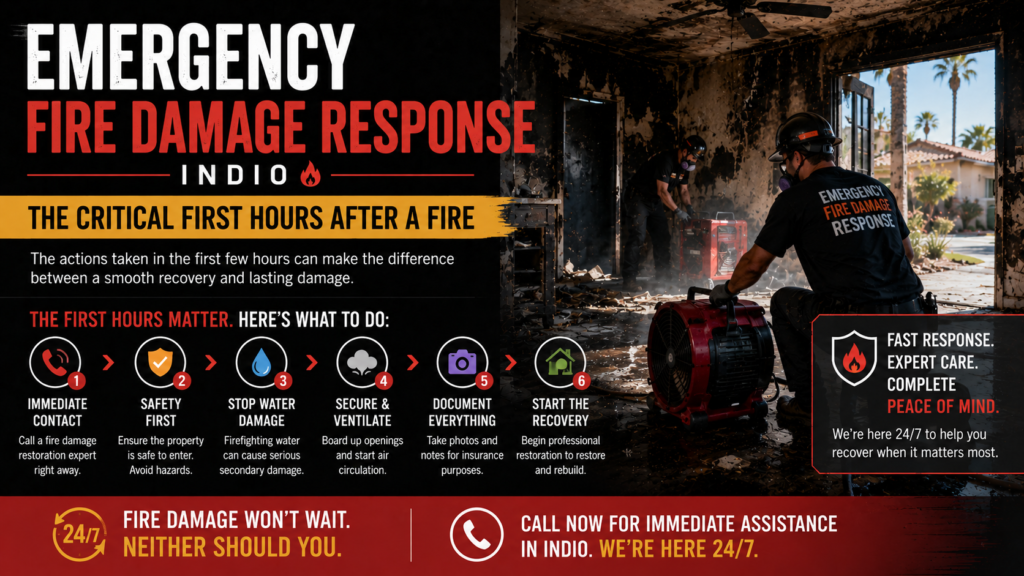
Many property owners are uncertain about what to expect when emergency fire damage response professionals arrive. The process is systematic and follows a well-established sequence designed to stop ongoing damage, secure the property, and set the stage for full restoration.
Initial assessment and safety verification is the first priority. No work begins until the structural safety of the building has been evaluated. Fire degrades structural integrity in ways that are not always immediately obvious. A ceiling that appears intact may be holding water weight that makes it a collapse hazard. Walls may have lost structural connections. Floors may be weakened. Professional response teams identify these hazards before any personnel enter affected areas.
Utility isolation follows. Electrical systems that were potentially compromised by fire or firefighting water present serious risks. Gas lines that may have been damaged need to be evaluated and shut off by appropriate utility personnel. Water supply lines affected by heat may need to be isolated. These steps prevent secondary emergencies during the response process.
Structure securing and board-up addresses the physical openings created by the fire event. Missing windows, holes in roofs, damaged doors, and other openings are covered and secured to prevent weather intrusion, unauthorized access, and animal entry. In Indio, where daytime temperatures in summer can exceed 110°F, an unsecured opening allows extreme heat to continue degrading materials inside the structure.
Content Protection and Inventory
A critical but often underappreciated aspect of emergency fire damage response is the management of contents the personal belongings, furnishings, electronics, documents, and valuables inside the property. Professional response teams conduct an initial inventory and assessment of contents, categorizing items as salvageable, potentially salvageable with specialized treatment, or non-salvageable.
Salvageable contents are often moved to an on-site clean area or transported to a secure off-site facility where they receive specialized cleaning, deodorization, and storage during the structure restoration process. Electronics are handled with particular care smoke and soot residues inside electronics can cause component failure and create fire hazards if devices are powered on without professional cleaning.
Document recovery is another specialized aspect of content management. Fire-damaged documents, photographs, and records may be salvageable through freeze-drying and other conservation techniques that must begin quickly to be effective.
Immediate Soot Mitigation
While full soot cleaning is a later-phase process, emergency response includes immediate mitigation of soot spread. Containment barriers are established to prevent unaffected areas of the structure from receiving soot and smoke residue carried by foot traffic or air movement. Porous surfaces in affected areas may receive initial dry-sponge cleaning to remove loose soot and prevent it from being ground into materials.
HVAC systems are shut down and registers are sealed to prevent the system from circulating soot-laden air into unaffected areas of the structure. This simple step can prevent smoke damage from extending far beyond the originally affected zone.
Water Removal and Drying Initiation
Firefighting water typically has to be addressed before any meaningful cleaning or assessment work can proceed. Standing water is extracted using professional equipment, and the drying process is initiated with the placement of air movers and dehumidifiers. In Indio’s desert climate, the low ambient humidity actually provides some advantage in the drying process drier outside air, when properly managed, can assist the dehumidification process.
However, the same desert heat that helps drying can complicate it if equipment is not properly sized and placed. Professional response teams account for ambient conditions when designing their drying systems.
Documentation from Day One
Insurance recovery from a fire loss depends heavily on documentation. Emergency fire damage response professionals generate documentation throughout the response process photographs of all affected areas, moisture readings, content inventories, and written descriptions of conditions observed. This documentation creates a baseline record of the scope and nature of damage that supports the insurance claim and protects property owners in the event of disputes.
Indio property owners should be aware that insurance companies typically have provisions requiring prompt notification of loss and cooperation with the claims process. Engaging professional emergency response services early ensures that the property is handled in a manner consistent with insurance requirements.
Common Questions About Emergency Response After a Fire
Is it safe to re-enter my home after the fire department leaves? Not necessarily. The fire department’s clearance to re-enter relates to immediate fire hazards, not structural safety or air quality. A professional assessment is advisable before spending time inside a fire-damaged structure.
Can I clean smoke damage myself? Attempting to clean soot and smoke damage without professional training and equipment often worsens the outcome. Rubbing soot into surfaces, using incorrect cleaning agents, or failing to address smoke in concealed areas can permanently damage materials that would otherwise have been salvageable.
What should I take from the property immediately? Important documents, medications, irreplaceable items like photographs, and any electronics that were in unaffected areas of the structure are priorities. Professionals should handle the contents of actively affected areas.
Does emergency response affect my ability to file an insurance claim? Professional emergency response typically facilitates, rather than complicates, the claims process. Reputable response companies are experienced in working with insurance adjusters and documenting their work in ways that support claims.
The hours immediately following a fire are not the time to wait and see. Proactive, professional emergency fire damage response in Indio sets the foundation for the most effective possible recovery protecting what can be saved, documenting what cannot, and initiating the path back to a safe, restored property.